Introduction
The previous articles in this series established that psilocybin is a prodrug converted to the active compound psilocin, and that psilocin engages serotonin receptors to produce its characteristic pharmacological effects. What hasn't yet been covered in detail is what happens next, the specific enzymatic machinery that carries out that conversion, the further biotransformation psilocin undergoes once it's done its job at the receptor, and the metabolites that ultimately leave the body.
This matters for more than academic completeness. Metabolic pathway data determines drug interaction risk, explains why clinical researchers measure psilocin rather than psilocybin in blood samples, and underpins the detection windows used in toxicology and analytical testing. This article walks through that pathway in the order the body actually processes it, from initial dephosphorylation through hepatic biotransformation to final excretion, drawing on recent enzymology and pharmacokinetic studies throughout.
As with the rest of this series, this is a scientific and educational explainer. It does not address dosing, sourcing, or use of psilocybin.
Step One: Dephosphorylation
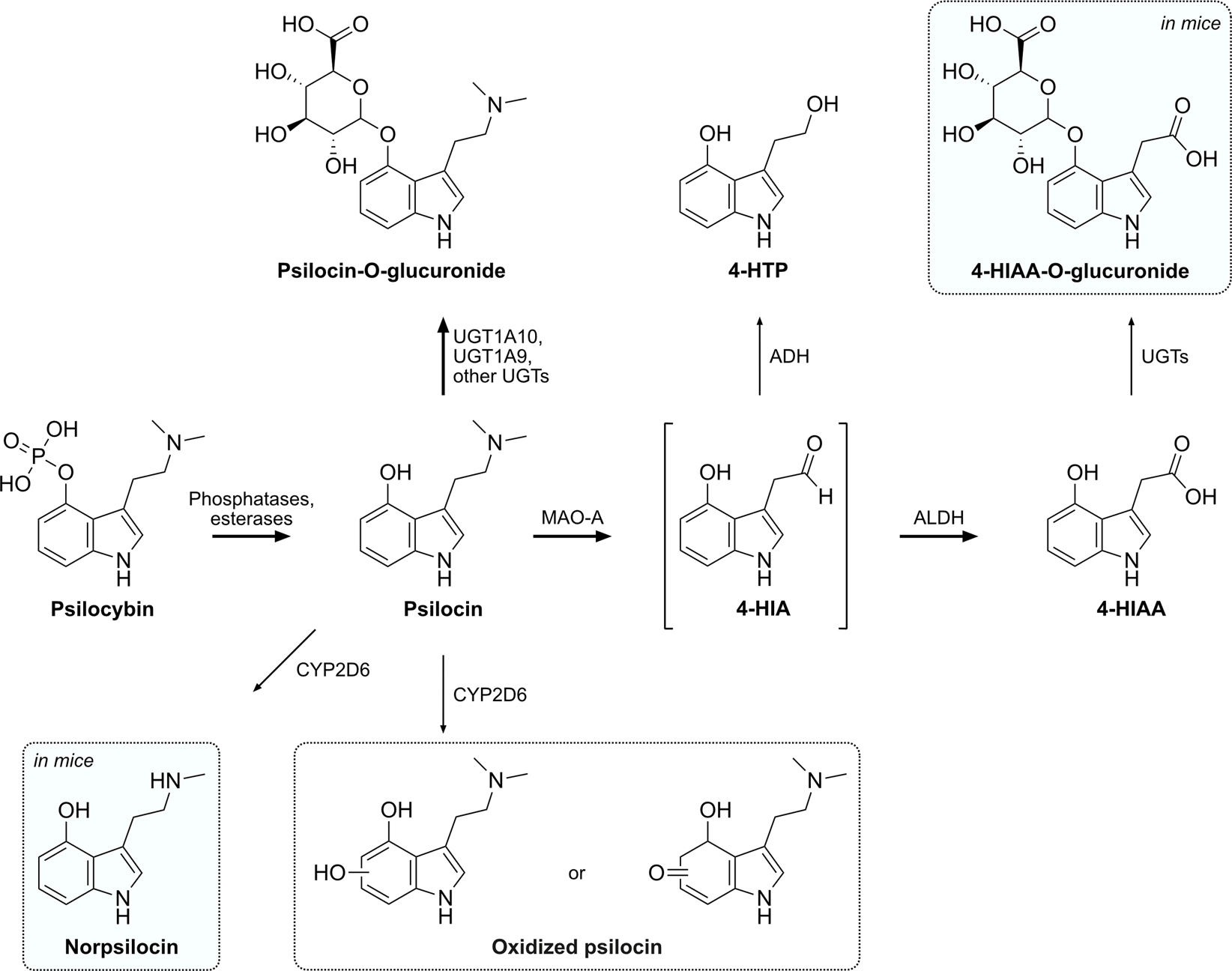
Metabolism begins almost immediately after oral ingestion. Psilocybin's phosphate ester group is rapidly cleaved by alkaline phosphatase enzymes, primarily in the intestinal wall, along with some contribution from non-specific esterases and further processing in the liver. This dephosphorylation step converts psilocybin into psilocin and happens quickly enough that intact psilocybin is difficult to detect in plasma in any meaningful concentration or for any meaningful duration after ingestion.
This has a specific, practical consequence for how psilocybin research is actually conducted: because psilocybin itself clears the bloodstream so quickly, essentially all downstream pharmacokinetic research, plasma concentration curves, half-life calculations, dose-response modeling, is built around measuring psilocin rather than psilocybin. Recent physiologically based pharmacokinetic (PBPK) modeling work explicitly builds this assumption into its structure, treating psilocybin as undergoing complete conversion to psilocin before the metabolite enters systemic circulation, rather than modeling meaningful residual psilocybin exposure at all.
Step Two: Psilocin's Two Major Metabolic Routes
Once formed, psilocin does not persist unchanged for long. It undergoes further biotransformation through two principal pathways: hepatic oxidative metabolism via cytochrome P450 (CYP) enzymes and monoamine oxidase, and conjugation via glucuronidation. Both routes are well characterized in current literature, and both ultimately produce metabolites with negligible or no receptor activity of their own.
The CYP450 Pathway
A detailed 2024 enzymology study using human liver microsomes and individual recombinant CYP enzymes found that psilocin is a substrate for multiple cytochrome P450 isoforms, with CYP2D6 and CYP3A4 playing the dominant roles. In that study, recombinant CYP2D6 metabolized nearly 100% of the psilocin substrate under the tested conditions, while recombinant CYP3A4 metabolized roughly 40%; overall, human liver microsomes metabolized approximately 29% of psilocin during the study's incubation period. A separate, independent systematic review of psilocybin pharmacokinetics reaches a consistent conclusion, identifying CYP2D6 and CYP3A4 as the primary enzymes responsible for psilocin metabolism, with monoamine oxidase A contributing as a secondary pathway.
The CYP450 route produces two principal downstream metabolites: 4-hydroxyindole-3-acetic acid (4-HIAA) and 4-hydroxytryptophol (4-HTP). In the human liver microsome experiments, both of these metabolites were detected, but notably, neither appeared when psilocin was incubated with the recombinant CYP enzymes alone, indicating that their formation depends on additional enzymatic steps present in the fuller liver microsome system but not captured by any single recombinant CYP enzyme in isolation. Separately, monoamine oxidase A was also found capable of transforming psilocin into small amounts of both 4-HIAA and 4-HTP, though only in comparatively minimal quantities relative to the CYP-mediated route. Critically for safety and interaction considerations, neither 4-HIAA nor 4-HTP showed meaningful activity at the serotonin receptors tested in that study, both are pharmacologically inactive dead-end metabolites rather than compounds with any residual psychoactive potential.
This CYP2D6/CYP3A4 dependency is the specific mechanistic reason psilocybin carries real drug-interaction risk. Both enzymes are involved in the metabolism of a very large number of other medications, and CYP2D6 in particular is subject to well-documented genetic polymorphism, meaning individuals can be classified as poor, intermediate, extensive, or ultrarapid metabolizers at this enzyme depending on their genotype. A person with reduced CYP2D6 activity, whether due to genetics or a co-administered CYP2D6-inhibiting drug, would be expected to clear psilocin more slowly than an extensive metabolizer, a pharmacokinetic variable with direct relevance to both research trial design and any future clinical application.
This genetic variability is not a purely theoretical concern in the psychedelic research context, it intersects directly with the classes of medication most likely to be co-prescribed to the patient populations being studied. Selective serotonin reuptake inhibitors (SSRIs), a mainstay of depression treatment and therefore a medication class of direct relevance to psilocybin's most-studied clinical application, include several well-known CYP2D6 inhibitors. This creates a layered pharmacokinetic question for trial designers: not only does psilocin's own clearance depend on CYP2D6 activity, but many of the patients most likely to be enrolled in psilocybin depression trials may already be taking, or recently tapering off, medications that directly affect that same enzyme system. This is part of why many clinical psilocybin trials to date have required a washout period from antidepressant medication before dosing, a design choice with both pharmacodynamic and pharmacokinetic justification.
The Glucuronidation Pathway
The second major route is Phase II conjugation: glucuronidation of psilocin to form psilocin-O-glucuronide, a considerably more water-soluble compound suited for renal and biliary excretion. This pathway is mediated primarily by UDP-glucuronosyltransferase enzymes, with UGT1A9 identified as the primary contributor in the liver and UGT1A10 contributing at the intestinal level.
Interestingly, in vitro enzymology work has found a discrepancy between what's observed in living systems and what recombinant UGT1A10 alone produces in isolated assay conditions, UGT1A10 did not extensively metabolize psilocin to the degree that in vivo data would predict, suggesting the full picture of intestinal and hepatic glucuronidation involves additional enzymatic contributors, or synergistic effects between enzymes, that aren't fully captured by testing any single recombinant UGT enzyme on its own. This is a useful reminder that in vitro enzymology, while essential for identifying candidate pathways, doesn't always fully replicate the complexity of intact liver and intestinal tissue, a limitation the same research explicitly acknowledges regarding Phase II metabolism specifically.
Psilocin-O-glucuronide itself is considered pharmacologically inactive. Clinical human data confirms this compound as one of the two major urinary metabolites, alongside 4-HIAA, and its formation is significant enough that a substantial fraction of a psilocybin dose is eliminated through this route rather than the oxidative CYP450 pathway.
Minor and Species-Specific Metabolites
Beyond the two dominant pathways, metabolism research has identified additional minor products worth noting for completeness. CYP2D6-mediated metabolism can produce a compound called norpsilocin (N-methyl-4-hydroxytryptamine), this has been observed both in vitro and in living mice, though it has not been detected in human plasma samples to date, suggesting either a genuinely different metabolic profile in humans or simply a concentration too low to detect with current methods. Separately, researchers have also identified an additional, structurally uncharacterized oxidized metabolite in human and mouse plasma, tentatively identified by its mass spectrometry fragmentation pattern as bearing an extra oxygen atom on the indole ring, though the precise structure and site of oxidation remain unconfirmed and would require further nuclear magnetic resonance or high-resolution mass spectrometry work to fully resolve.
This incomplete picture is a useful, honest reminder that even a well-studied compound like psilocybin still has open questions in its basic metabolic map, not every minor metabolite has been fully characterized, and cross-species differences (present in mice, absent or undetected in humans) complicate simple extrapolation from animal to human metabolism.
It's worth pausing on why this incompleteness persists even now, given how much clinical and pharmaceutical attention psilocybin has received in recent years. Fully characterizing a minor metabolite typically requires isolating enough of the compound in pure form to run nuclear magnetic resonance spectroscopy, or obtaining sufficiently clean high-resolution mass spectrometry data to confidently assign a structure rather than merely a molecular mass and a plausible fragmentation pattern. When a metabolite is present only in trace concentrations, as appears to be the case for the unidentified oxidized metabolite noted above, that experimental bar can be difficult to clear even with modern analytical instrumentation, which is why some open questions in psilocybin's metabolic map are likely to persist until either more sensitive methods become standard or a research group specifically prioritizes resolving that particular structural question.
Species Differences: Why Mouse Data Doesn't Map Directly Onto Humans
The metabolic pathways described above are broadly conserved between rodents and humans, but the relative contribution of each pathway, and the resulting elimination kinetics, differ meaningfully by species. This is a recurring theme across psilocybin pharmacology research generally, and metabolism is no exception.
Recent PBPK modeling work explicitly built separate model structures for mice, rats, and humans specifically because a single unified model could not adequately capture the disposition differences between species, including how psilocin distributes to and accumulates within the brain, the target organ of pharmacological interest. This is a meaningful methodological point: it means findings from mouse metabolism studies, while useful for identifying which enzymes and pathways are likely relevant, cannot be assumed to predict human elimination half-life, metabolite ratios, or drug interaction magnitude without direct human confirmation.
Quantifying the Metabolic Half-Lives
Beyond identifying which enzymes and pathways are involved, recent research has also quantified how quickly downstream metabolites themselves are cleared. In mouse pharmacokinetic studies, 4-HIAA was found to have a somewhat shorter elimination half-life than its glucuronide conjugate, approximately 0.75 hours for free 4-HIAA compared to roughly 1.38 hours for 4-HIAA-glucuronide. This kind of granular metabolite-level half-life data is directly useful for toxicology and analytical work, since it affects how long after ingestion a given metabolite remains detectable and in what relative proportion to its parent compounds.
Human renal excretion data, drawn from controlled dosing studies, adds a further layer of detail. Peak urinary psilocin concentrations have been measured as high as roughly 870 micrograms per liter in urine samples collected two to four hours after dosing, with an excretion rate during that window of approximately 55 micrograms per hour. Within 24 hours, only a small fraction, roughly 3–4%, of the administered psilocybin dose is excreted as free, unconjugated psilocin, underscoring just how much of the compound is routed through the glucuronidation and oxidative pathways rather than being eliminated unchanged. That same research found that treating urine samples with beta-glucuronidase, an enzyme that hydrolyzes glucuronide conjugates back into their free form, roughly doubled measured free psilocin concentrations, direct experimental confirmation of how much psilocin is normally present in urine specifically as the glucuronide conjugate rather than in free form, and a methodological detail directly relevant to how forensic and clinical urine testing protocols need to be designed.
That same excretion study also illustrates a practical laboratory constraint that anyone doing analytical work on psilocin needs to account for: during the beta-glucuronidase incubation step used to unmask conjugated psilocin, a meaningful fraction of the liberated free psilocin, on the order of 18% in that dataset, was itself lost to decomposition over the several-hour incubation period. That finding is a direct experimental demonstration of the same oxidative instability discussed in the Psilocybin vs Psilocin article: even under controlled laboratory conditions, deliberately designed to preserve the compound wherever possible, some quantity of free psilocin degrades over a period of hours once it is no longer protected in its stable phosphorylated or glucuronidated form. Any excretion or metabolite-ratio study working with free psilocin has to build this decomposition rate into its methodology, or risk systematically underestimating how much psilocin was actually present at the moment of sample collection.
Why This Matters for Clinical Research Design
The metabolic picture described above has direct, practical implications for how psilocybin clinical trials and pharmacokinetic studies are designed and interpreted:
- Drug interactions. Co-administration of strong CYP2D6 or CYP3A4 inhibitors or inducers could meaningfully alter psilocin exposure and elimination, a consideration increasingly built into clinical trial exclusion criteria and concomitant medication screening.
- Genetic variability. CYP2D6 polymorphism means individual variability in psilocin clearance is expected on pharmacogenetic grounds alone, independent of any drug interaction.
- Metabolite-based assay design. Because psilocybin itself is essentially undetectable shortly after ingestion, any pharmacokinetic or forensic assay needs to be built around psilocin and its named downstream metabolites rather than psilocybin directly, a detail covered in more analytical depth in the Analytical Testing of Psilocybin Materials article later in this series.
- Cross-species translation limits. Because the relative weighting of metabolic pathways differs between rodents and humans, dose-timing and metabolite-ratio findings from animal studies require direct human confirmation before being applied to trial design.
Frequently Asked Questions
What is the first step in psilocybin metabolism? Psilocybin is rapidly dephosphorylated, primarily by alkaline phosphatase enzymes in the intestinal wall, converting it into its active metabolite, psilocin, within minutes of ingestion.
Which enzymes metabolize psilocin? Psilocin is metabolized primarily by the cytochrome P450 enzymes CYP2D6 and CYP3A4, with a secondary contribution from monoamine oxidase A. Separately, it is conjugated via glucuronidation, primarily by UGT1A9 in the liver and UGT1A10 in the intestine.
What are the main metabolites of psilocybin? The two major inactive metabolites are 4-hydroxyindole-3-acetic acid (4-HIAA) and psilocin-O-glucuronide. Minor metabolites include 4-hydroxytryptophol and, in some species, norpsilocin.
Can drug interactions affect psilocybin metabolism? Yes. Because psilocin is metabolized significantly through CYP2D6 and CYP3A4, enzymes involved in metabolizing many other medications, co-administered drugs that inhibit or induce these enzymes could meaningfully alter psilocin's clearance and exposure levels.
Why do researchers measure psilocin instead of psilocybin in blood tests? Because psilocybin is converted to psilocin so rapidly after ingestion, intact psilocybin is difficult to detect in blood plasma in any meaningful amount. Nearly all pharmacokinetic and toxicological assessment of psilocybin exposure is therefore based on measuring psilocin and its downstream metabolites instead.
Does psilocybin metabolism work the same way in animals and humans? The core pathways are broadly similar, but the relative contribution of each pathway and the resulting elimination kinetics differ between species. This is why researchers build separate pharmacokinetic models for different species rather than assuming animal data translates directly to humans.
Key Takeaways
- Psilocybin is rapidly dephosphorylated to psilocin, primarily via alkaline phosphatase in the intestinal wall, making intact psilocybin difficult to detect in plasma.
- Psilocin is metabolized through two major pathways: oxidative metabolism via CYP2D6 and CYP3A4 (with monoamine oxidase A as a secondary route), and glucuronidation via UGT1A9 and UGT1A10.
- The major downstream metabolites, 4-HIAA, 4-hydroxytryptophol, and psilocin-O-glucuronide, are considered pharmacologically inactive.
- CYP2D6's well-documented genetic polymorphism and role in metabolizing many other drugs make it a specific, mechanistically grounded source of psilocybin drug-interaction risk.
- Metabolic pathway weighting differs between species, meaning animal pharmacokinetic data requires direct human confirmation before clinical application.
- A small fraction of ingested psilocybin, roughly 3–4%, is excreted unchanged as free psilocin within 24 hours; the majority is eliminated via glucuronide conjugation or oxidative metabolites.
This article is for scientific and educational purposes only. It does not provide guidance on acquisition, dosing, or use of psilocybin, and is not a substitute for professional medical or legal advice.